Offer Generation for Sales Calls With a Board of LLM Agents
Overview
Key Highlights
Role-playing agents
Each agent has a role, a description, a goal, its own knowledge source, and business rules. A mandatory "Boss" agent listens to the others and makes the final decision.
Offer as a conclusion
Every discussion ends with a clear offer, advice, or action steps that the representative can use.
Configurable board
Agents are created and edited by the client's team in a web application, without code changes, and a discussion can be re-run after any change.
Live discussion view
Agent messages are streamed to the browser as they are generated, together with a customer satisfaction assessment of the conversation.
The Challenge
- Scattered knowledge: Order history, stock, customer records, and marketing data live in different systems. No single prompt could hold all of it, and no single person could read all of it during a call.
- Decision, not just analysis: Earlier workstreams described a call. This one had to end with a concrete proposal, every time, in a form a representative could act on.
- Trust in the output: An offer produced by an LLM can sound confident and still be wrong. The client's team had to be able to see how the offer was reached and change the rules behind it.
- Moving target: Multi-agent LLM frameworks were new and changing weekly during the project. The design had to allow swapping models and discussion strategies without rewriting the application.
The Journey
-
Scoping the Opportunity
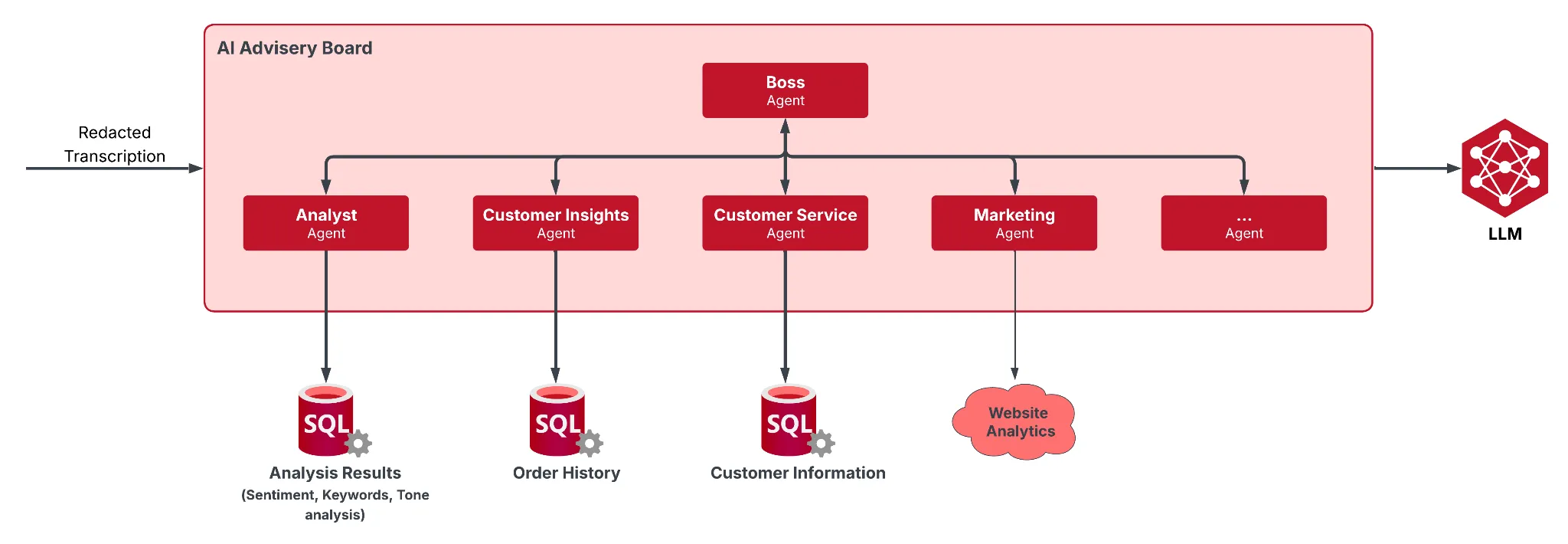
Together with the client we chose the role-play approach, inspired by published multi-agent research such as CAMEL and multi-agent debate. Instead of one large prompt, the problem is split between several agents, each one responsible for one source of knowledge. The first board was defined from the people a sales manager would normally ask: an analysis agent with the call analysis results, a customer insight agent with order history, a customer service agent with customer information, a marketing agent with website analytics, and a Boss who hears everyone and decides.
The input to the board is the redacted transcript produced by the earlier workstreams, so only masked text reaches the external LLM. For the real-time use case the transcript grows turn by turn as the call goes on.
-
Strategic Development
We built the AI Advisory Board in two parts: a Python library that runs the discussion, and a sandbox web application where the client's team configures agents and watches discussions.
The discussion follows a fixed protocol:
- A moderator step turns the conversation so far into one question to answer, such as "What should we offer this customer right now?". The question can also be set by the user, or chosen automatically from customer data.
- A separate step rates the customer's satisfaction in the conversation as normal, disappointed, or dissatisfied, so the board and the representative know how urgent the situation is.
- Each agent answers from its own role definition and knowledge only.
- The Boss agent asks the others questions, and after a few rounds closes the discussion with a conclusion that contains the offer.
Four discussion strategies were implemented and exposed as a setting: agents speak in turn; the Boss picks who speaks next; the Boss asks everyone and then decides; and the same with agents isolated from each other within a round. The client can switch between them and see which one gives the better offer for their case.
-
Iterative Execution
Because a live call cannot be replayed, the board was developed and tested on redacted transcripts of real calls, fed in turn by turn as they would arrive during a live call. The offers were reviewed with the client. Three things shaped the next iterations:
- Offers needed validation. An offer can only be judged by someone who knows the business, so the client's own team was brought into the loop. The sandbox application was built for them: they could paste or import a conversation, type new client and representative lines, run the board, and read every agent's message, not just the final offer.
- Agent configuration was the real work. The quality of an offer depended on the agent's description, goal, and knowledge more than on the model. We moved all of this, including business rules, into agent settings that the client's team edits in the application.
- Long discussions drifted. Agents started to repeat each other. We worked out a way to keep the discussion short and on topic, and to let the Boss close it once the point is clear.
Technology Choices
- Large language model: OpenAI chat models through the OpenAI API, with the model name as a setting so it can be changed without a code change.
- Agent framework: LangChain for the agent abstraction, message history, and output parsing. Our own library adds the director agent, the discussion strategies, and the question and satisfaction steps.
- Sandbox application: Django REST Framework on PostgreSQL for agent configuration and discussion control, Vue 3 and TypeScript on the frontend. Agent messages appear in the browser as they are generated, so a discussion can be watched and stopped.
- Deployment: The application is containerized and deployed to the client's Kubernetes cluster next to the transcription and analysis services, so transcripts stay on the cluster and only redacted text goes to the LLM API.
The Results
Conclusion
Key Takeaways:
- Split the knowledge, not the prompt: One agent per knowledge source keeps each prompt small and makes the discussion readable.
- Always end with a decision: A mandatory decision-maker agent guarantees a concrete output every time.
- Configuration beats model choice: Offer quality depended on role definitions and knowledge far more than on the model, so make them editable by the business team.