Get in Touch

Context Enrichment Platform: Solution Overview 

Solution Overview

A platform that extracts contextual signals in the background and makes them available in real time for bidstream enrichment. New pages are processed asynchronously, while ready results are retrieved through a low-latency lookup layer and attached to bid requests before downstream targeting and safety logic runs.
The solution is designed to scale efficiently (with throughput in the tens of pages per second per worker for the enrichment stage, broadly in line with similar analysis systems), avoid duplicate processing, and support clear performance and cost measurement.
The same approach can also be applied to mobile inventory, extending the product beyond web content when needed.

What the Solution Produces

For each page or content unit, the platform creates a compact enrichment record that can be inserted into the bidstream or used by downstream systems. Core outputs include:
  • Language
  • Contextual categories (IAB)
  • Brand safety labels
  • Keywords
  • Sentiment
  • Entities (NER)
These outputs provide a practical foundation for contextual enrichment today and can be extended over time without major architectural changes.

Solution Flow

Request or batch trigger enters the platform

A page request can arrive through a lookup path, or the system can be triggered through batch workflows for backfills, reprocessing, or refresh campaigns.

Existing result is checked first

The platform checks whether a recent enrichment snapshot is already available. If so, the result can be served immediately. If not, the page is queued for processing. This avoids unnecessary repeat work, improves response time for already known pages, and supports cost-efficient operation at scale.

Content is fetched and normalized

New pages move through a fetch and extraction stage where source content is retrieved, cleaned, and normalized into a structured input suitable for downstream enrichment.

Enrichment generates and stores the page signals

The enrichment layer runs a multi-step context extraction process that analyzes page content, derives signals such as categories, safety labels, keywords, sentiment, and entities, and stores the result for lookup and reuse.

Enrichment is added to the bidstream

When a bid request is made, the stored enrichment record is attached to the request and made available for downstream targeting and safety logic.
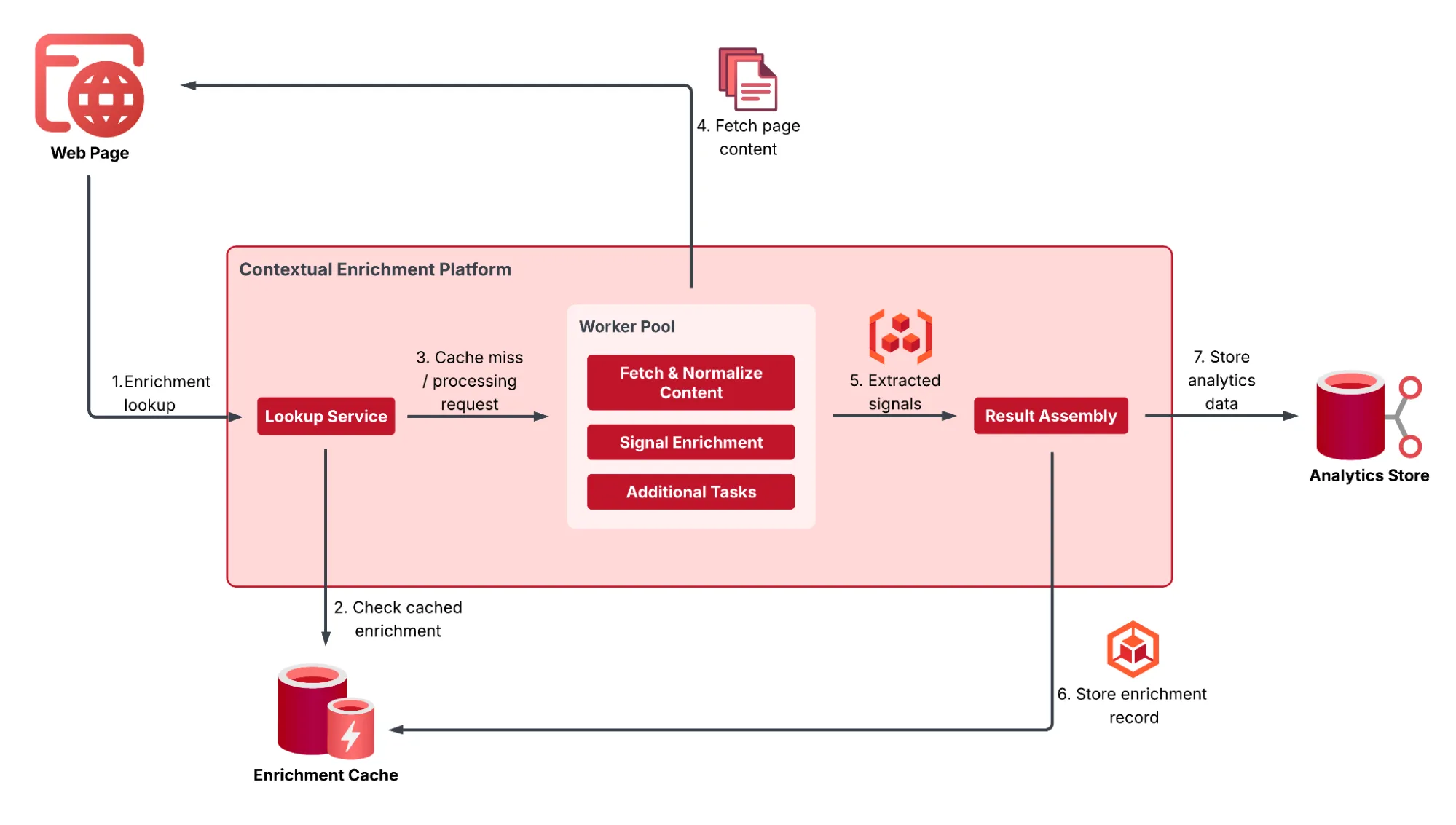
Context enrichment platform: a bid request’s enrichment lookup, the cache check, the worker pool that fetches, normalizes and enriches new pages, result assembly, and the enrichment cache and analytics store

Performance and Cost

The current benchmark provides a practical baseline for planning. It shows throughput in the ~100+ pages/sec range per process, with NLP-stage throughput in the tens of pages per second per worker, which is broadly consistent with similar analysis systems. On a standard CPU worker, raw extraction cost remains in the 0.001-0.01 per 1,000 pages for the non-LLM path, depending on the final throughput per worker and infrastructure scaling strategy.
For scale reference, 100M pages would require about 200 GB in the cache layer, with storage-only cost roughly in the ~$35–50/month range. In practice, storage is just one part of the budget: supporting fast cache lookups in real time, with response times in the low tens of milliseconds, and running background enrichment at the required scale will require additional compute and traffic capacity, so a realistic 100M-page deployment should be planned from roughly $800/month upward as a starting point. CPU/GPU choice will also influence performance and budget: the platform can start from a cost-efficient CPU baseline and scale to use GPUs for the heavier enrichment stages when higher throughput justifies it.