A Modern Analytics Pipeline for AdTech: Highfivve’s Journey to Full Analytics Ownership
Overview
Key Highlights
Full Ownership of Monetization Analytics
Highfivve controls event collection, retention, enrichment, and aggregation end-to-end.
Cost-Efficient Infrastructure
The pipeline runs entirely on existing datacenter components, reducing recurring costs.
Built for Scale
Designed to process ~75M events/day with hourly - or faster - aggregations.
Operational Independence
Schemas, event formats, enrichment logic, and A/B testing labels are fully owned and customizable.
Modern Analytics Architecture
A Bronze → Silver → Gold pipeline ensures transparency, safe reprocessing, and long-term maintainability.
The Challenge
Vendor lock-in limiting flexibility
The external analytics platform offered limited flexibility for controlling event fields, retention strategy, or aggregation logic, making it difficult for Highfivve to evolve its monetization analytics processes in line with internal needs. Highfivve needed ownership, not black-box analytics.
High recurring operational costs
Relying on a third-party analytics platform introduced ongoing operational expenses while limiting Highfivve’s ability to optimize long-term cost structure. By moving analytics in-house, Highfivve aimed to reduce recurring costs and better utilize its existing infrastructure.
Data transparency and operational control needs
Highfivve’s data team required full visibility into raw events and the ability to validate, correct, and reprocess specific time windows - capabilities essential for ensuring consistent, reliable analytics aligned with internal reporting workflows. Operating an in-house pipeline provides complete transparency and end-to-end control.
The Journey
-
Discovery & Requirements Definition
Together, Postindustria and Highfivve mapped the full end-to-end analytics flow: from browser event generation to operational dashboards. The teams aligned on strict data minimization rules (collect only what is needed), compliance constraints, and integration with existing infrastructure. This phase established five core workflows: browser event collection, ingestion, enrichment, aggregation, and analytics access.
-
Designing for Ownership and Cost Efficiency
The final architecture followed a Bronze → Silver → Gold model:
- Bronze: Raw events via Kafka → AWS S3
- Silver: Enriched, deduplicated events in ClickHouse
- Gold: Hourly & daily aggregated metrics powering operational analytics
This architecture ensured:
- full transparency at every stage
- safe reprocessing of any hour or day
- predictable long-term storage costs
- simplicity aligned with Highfivve’s existing tech stack (Kafka, AWS S3, Airflow, ClickHouse)

-
Building an Independent Browser Analytics Module
A custom analytics module was embedded directly into the ad-tag, capturing only the essential Prebid and page-level signals needed for Highfivve’s operational metrics. This included key events such as auctionEnd and bidWon, with the module designed to remain flexible as additional event types or data points are required over time.
Beyond event collection, the module also handles batching, session tracking, event filtering, and A/B testing labels - all fully owned and controlled by Highfivve.
-
Creating a High-Throughput Ingestion Layer
The ingestion layer was built on Kafka with well-defined schemas, topic organization, and a hot-retention configuration designed to handle Highfivve’s traffic volume of approximately 75 million events per day. Dedicated DLQ (Dead Letter Queue) topics were added to safely isolate malformed or unprocessable messages, ensuring that data quality issues never interfere with the primary event stream.
In parallel, Highfivve’s development team implemented a specialized ingestion service that collects batched events directly from the ad-tag and forwards them into the appropriate Kafka topics. Delivered within a short timeframe, this component became the secure entry point for all browser-generated analytics data.
With this foundation in place, Highfivve gains a scalable, reliable, and fully owned entry point for all raw analytics events.
-
Enrichment & Deduplication Engine
The enrichment layer, orchestrated with Airflow and powered by Dask, allows Highfivve to process large volumes of events in parallel, with the ability to scale horizontally as more compute resources become available. This parallel model accelerates enrichment steps such as GeoIP resolution, browser detection, and data normalization while keeping execution predictable and fully controlled.
One of Highfivve’s requirements was the ability to adjust enrichment logic at any time and safely reprocess historical periods without risking inconsistencies in the final analytics. Relying solely on native ClickHouse deduplication mechanisms would have made deterministic, hour-by-hour rebuilding challenging, as ClickHouse table’s background merges are not tied to a precise execution schedule.
To address this, Postindustria implemented a controlled, partition-based deduplication and rebuild process in both the Silver and Gold layers. Each hour can be explicitly dropped, reprocessed, and reinserted, ensuring that updates, late-arriving data, or logic changes never result in duplicated or stale metrics.
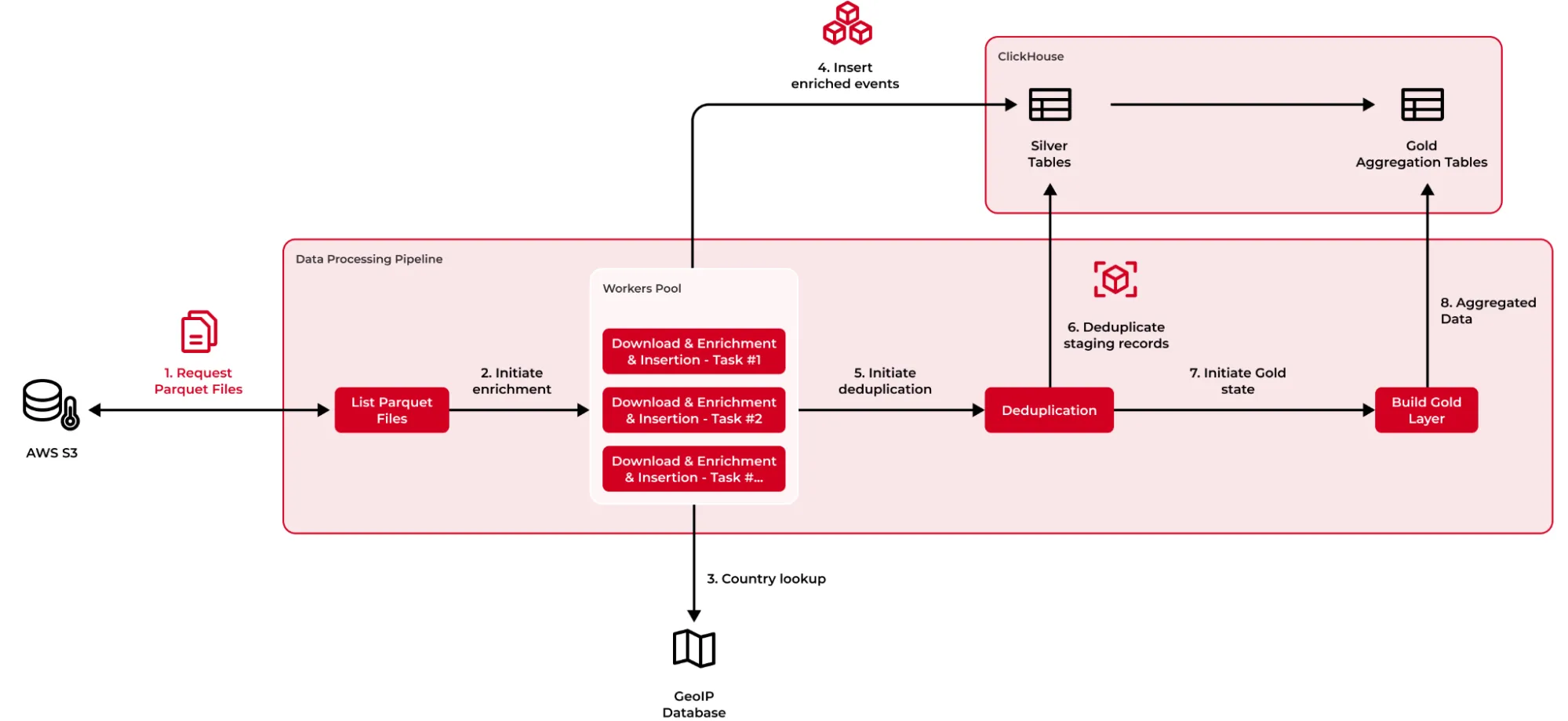
This approach gives Highfivve the flexibility to evolve processing logic, validate corrections, and run backfills across any time range with confidence.
-
Gold Cubes for Operational Analytics
At the final stage of the pipeline, the system produces hourly and daily Gold tables that consolidate all enriched events into pre-aggregated, query-ready metrics. Optimized for fast lookups, these cubes form the backbone of Highfivve’s analytics interface and support high-volume exploratory queries without accessing raw or Silver-layer data.
The Technology
- Core Architecture Bronze → Silver → Gold pipeline separating raw, enriched, and aggregated data.
- Browser Integration Custom ad-tag module for unified event capture, session tracking, and A/B test labels.
- Ingestion Layer Kafka intake with structured topics, hot retention, and DLQ routing for safe isolation of malformed events.
- Storage & Archive AWS S3 stores Parquet raw events, enabling durable retention and flexible reprocessing.
- Orchestration & Processing Airflow schedules Python-based enrichment tasks executed in parallel via scalable Dask workers.
- Enrichment & Deduplication ClickHouse hosts staging and canonical tables with deterministic partition rebuilds for consistent analytics.
- Deployment All services and workers are deployed using Nomad, aligning with Highfivve’s existing infrastructure.
- Analytical Cubes Hourly and daily ClickHouse cubes optimized for low-latency operational queries.
The Results
Complete Operational Independence
Highfivve fully owns event collection, processing, aggregation, and data retention - eliminating reliance on external analytics providers and enabling unbounded customization. Everything from event fields to pipeline logic is transparent and modifiable by the internal team.
Long-Term Cost Optimization
By running the pipeline on Kafka, AWS S3, and ClickHouse within its own infrastructure environment, Highfivve has created a foundation for reducing dependency on external analytics platforms. As the transition progresses, this architecture enables lower recurring costs and improved control over infrastructure spending.
Consistent, High-Integrity Analytics
By owning the full data flow - from event capture to hourly aggregations - Highfivve ensures that operational metrics follow a single, transparent logic aligned with its internal reporting workflows. This consistency strengthens day-to-day decision-making and reduces analytical blind spots.
Faster Operational Visibility
The new pipeline delivers hourly (and optionally more frequent) aggregations for auctions, impressions, bids, wins, and revenue. This same-day visibility helps Highfivve detect changes in performance sooner and respond more effectively to emerging issues.
Designed for Long-Term Maintainability
All technologies used (Airflow, Kafka, AWS S3, ClickHouse) align with Highfivve’s existing stack, allowing the data team to:
- extend schemas
- adjust enrichment logic
- introduce new event types
- rerun historical backfills
- evolve A/B testing strategies
without external dependency.
Conclusion
- transparency
- flexibility
- long-term cost optimization
- maintainability
- and end-to-end control of mission-critical monetization data